
Recently, the winners of the iF Design Award 2026 were officially announced. The project “Texture Axis” (TEXTURE AXIS), designed by a team led by teacher Pan Jingru from the School of Design at Central Academy of Fine Arts (CAFA), received the prestigious award.


The AI-empowered educational platform is a phased outcome of the National Social Science Fund of China (Youth Program in Art Studies) research project titled “Research on the Intervention of Digital and Intelligent Technologies in the Inheritance and Innovative Design of Decorative Patterns.”
About iF

Founded in 1954, the iF Design Award is one of the world’s most recognized design competitions. This year’s selection process was conducted by an independent jury of 129 leading international experts in design and sustainability, who evaluated more than ten thousand submissions through a rigorous and transparent process. The project’s recognition within the context of artificial intelligence highlights international acknowledgment of its platform-based research methodology and interdisciplinary collaborative approach.
AI Model Builder
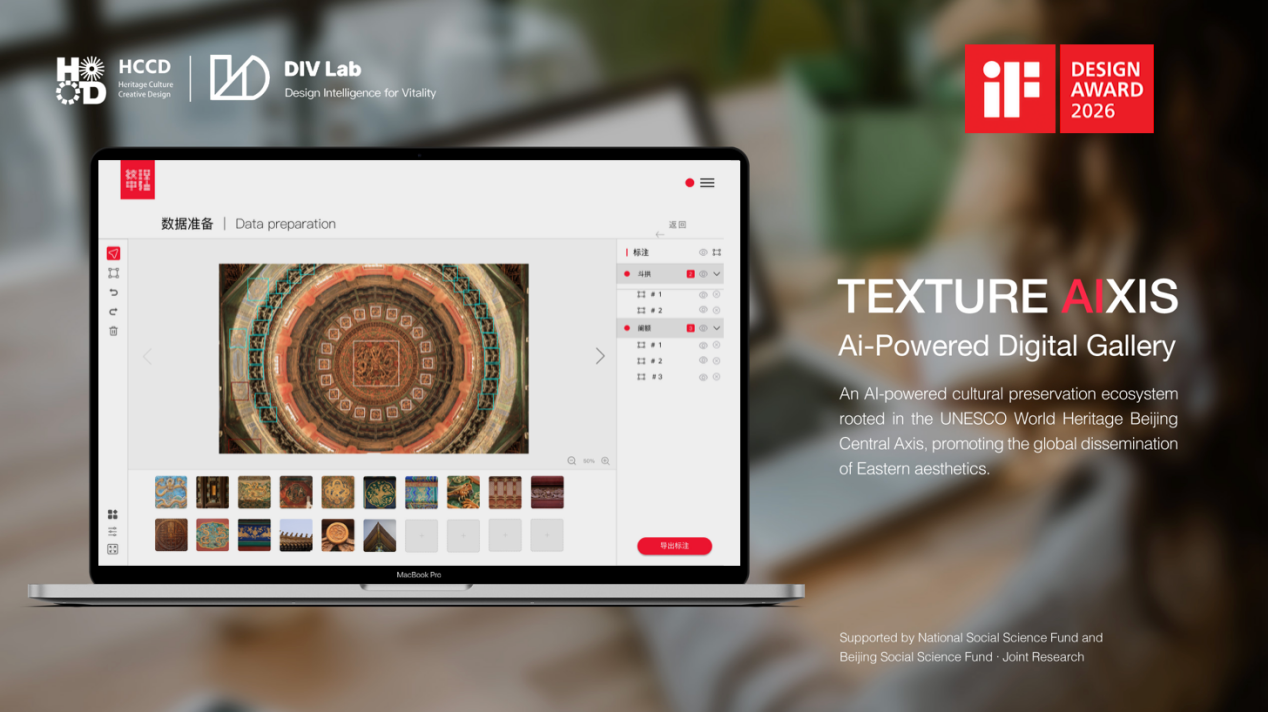
Taking the regional patterns of the Beijing Central Axis, a UNESCO World Heritage site, as its cultural core, “Texture Axis” builds an AI educational platform that integrates AI recognition model development, customizable tagging, model generation, and pattern data sharing.

Through intuitive functions such as small-sample uploads, intelligent annotation, one-click training, and testing, the platform lowers the technical barrier to AI model training. It enables teachers and students to transform the traditional “black box” of algorithms into an experimental process that can be demonstrated, discussed, and iteratively refined in teaching and research.
Design+Tech

The “Texture Axis” project was initiated by the HCCD team at the Central Academy of Fine Arts, in collaboration with the DIV Lab of the University of Macau and Beijing Institute of Technology. Computer vision AI technical support was provided by the DINO-X team of Vision Inspire Future.
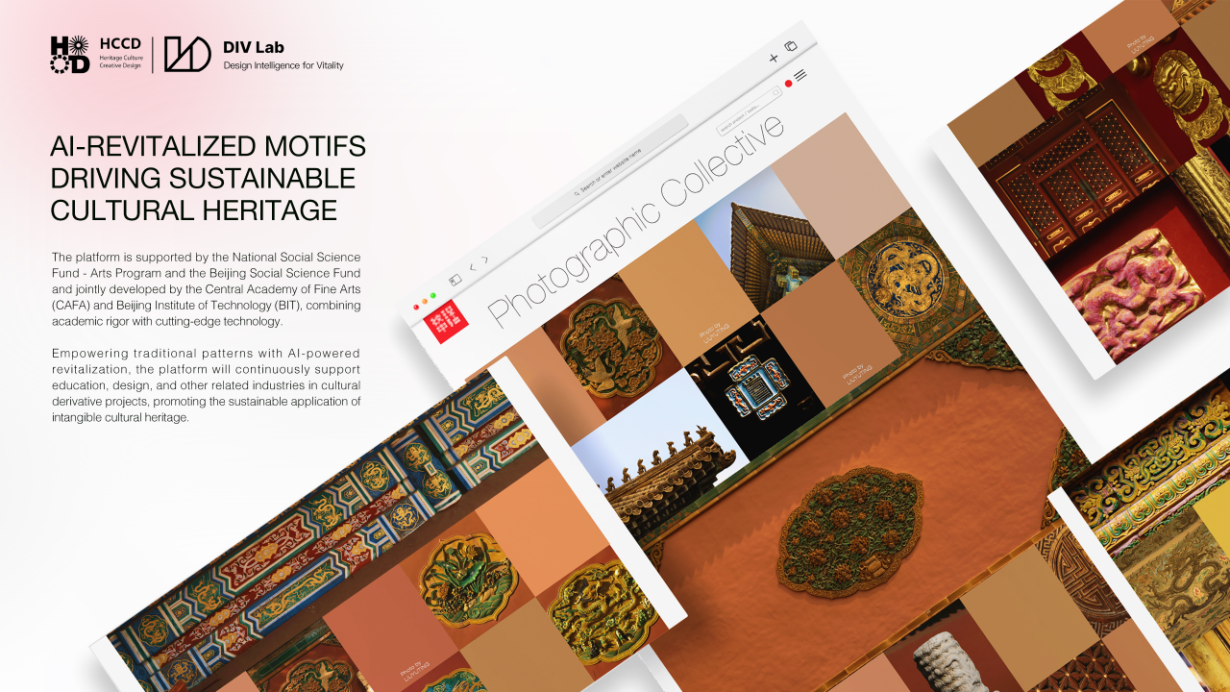
The platform also integrates open-source pattern resources related to multiple heritage sites along the Beijing Central Axis, including the Forbidden City and the Temple of Heaven. These materials were photographed and illustrated by CAFA students, enabling them to rediscover and reinterpret cultural resources through learning and creative practice.
National Confidence

Supported by cloud-based management and collaborative creation mechanisms, the platform will in the future allow users to export and share results with one click, connecting cultural heritage resources with design application scenarios. The mobile version will further explore scenario-based features such as photo recognition of patterns and real-time optimization.

Through this platform, the research team has already generated more than 100 AI models of traditional Chinese decorative patterns. The technical experiments have also been developed into multiple academic papers to be published in domestic and international scholarly journals. The project will continue to use artificial intelligence to activate and innovate traditional pattern design, supporting teaching, design research, and cultural-creative practices in related industries.
 Fifteen Days Learning from Antonio López in Spain at the Age of Ninety